Project Padayon: Supporting Children’s Education in Remote Communities
PHILIPPINES
At Sumitomo Corporation of the Philippines (SCOP), we have been working with the nonprofit organization Black Pencil Project to support children’s access to quality education in remote areas of the country. Our focus is not only on providing material support, but also on understanding local needs and fostering connections that can inspire and motivate students and teachers alike.
What is Project Padayon?
“Padayon” is a Visayan word meaning “to keep going.” Project Padayon was launched in 2019 as a Corporate Social Responsibility (CSR) initiative aimed at giving back to the community by expanding access to quality education and nurturing talent capable of addressing a wide range of social challenges. In partnership with the Black Pencil Project, we provide free school supplies to underprivileged Filipino children and encourage them to dream big about their future.
From the list of struggling schools provided by Black Pencil Project, we chose Labney Elementary School, a small, isolated school tucked deep in the mountains with very limited resources. We felt its remote location made it an ideal candidate for our initial efforts to make a lasting impact.
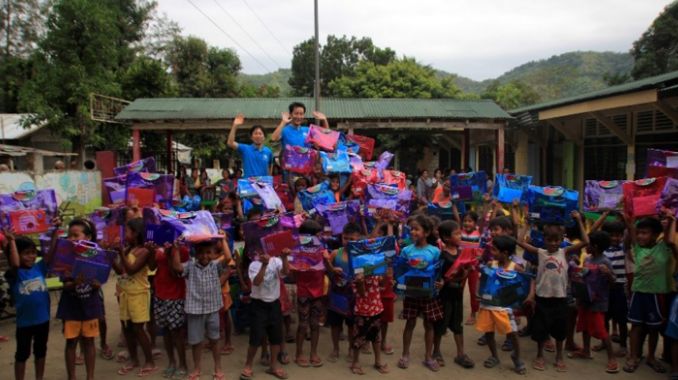
On January 25, 2020, our team of volunteers visited Labney Elementary School and distributed school supplies to 224 students from kindergarten to sixth grade, along with teaching kits for 10 teachers. We also helped repaint one of the school buildings and organized a food program for the children and the local community. Seeing the children’s excitement as they received their supplies was a deeply rewarding experience for all of us, and we were honored to receive a certificate of appreciation from the school afterward.
Returning After a Long Hiatus
The COVID-19 pandemic, along with security concerns during the election period, kept us from visiting for several years. In May 2024, we finally resumed our activities. A larger group of volunteers—including Filipino employees, Japanese expatriates, and their family members—set out early for the five-hour trip along rough roads and river crossings to reach the school in time for the 8:00 start.
Upon our arrival, we were encouraged to see how much the school had grown since our last visit. Now called Labney Integrated School, it had been renovated and expanded to include secondary-level classes, allowing older students in the area to continue their education without leaving their community.
The students welcomed us warmly with a short presentation, including a lively dance. Afterwards, our company president, who had joined the activity, gave a short speech before we handed out new school supplies to the children.
Following that, the volunteers toured the community and had lunch with local residents. Walking through the village and seeing firsthand where the students grew up and the conditions they live in helps us identify how to support them in meaningful ways. Members of the local community were particularly surprised and pleased to see Japanese expatriates, who are rarely present in such a remote area. These interactions highlighted how connections across cultures can strengthen education and community growth.
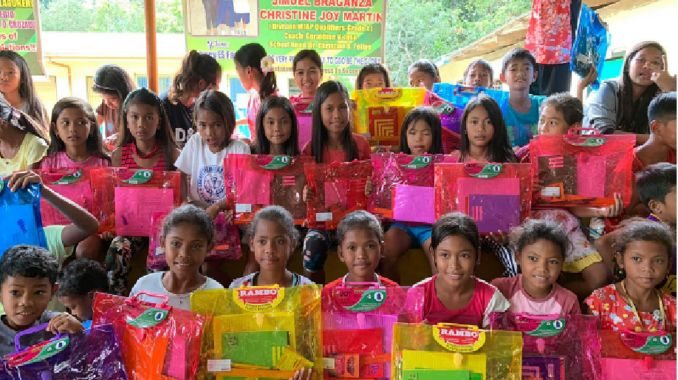
Labney Elementary School Children holding their school kits.
Making a Difference Over the Long Term
We choose to visit the same school over multiple years because, rather than carrying out a one-off activity, we want to make a lasting impact and observe how both the children and the school develop over time. Of course, the students and staff appreciate the supplies we provide, but the greater significance lies in how our interactions can positively influence the lives of children in a remote area. Even a single day spent connecting with people from outside the community can boost their motivation and confidence, and, as we’ve seen, the school itself has already begun to grow and evolve in ways that go beyond material resources.
From the volunteers’ perspective, the program also provided valuable insight into local educational conditions while strengthening relationships and team spirit among colleagues. The experience reinforced the value of continued engagement and offered a hopeful view of the students’ future. Participants who attended both visits were also struck by how much the children had grown and changed over the five years since the previous trip.
Inspired by the success of Project Padayon at Labney Integrated School, SCOP plans to expand the initiative in the coming year. A second school located in the mountains just outside Metro Manila has been identified as a potential partner, where we aim to provide supplies, food, and ongoing support to the local community. Through these activities, we hope to continue addressing inequality, breaking cycles of poverty, and improving educational outcomes for Filipino children, while fostering long-term connections that strengthen both the students and the communities around them.
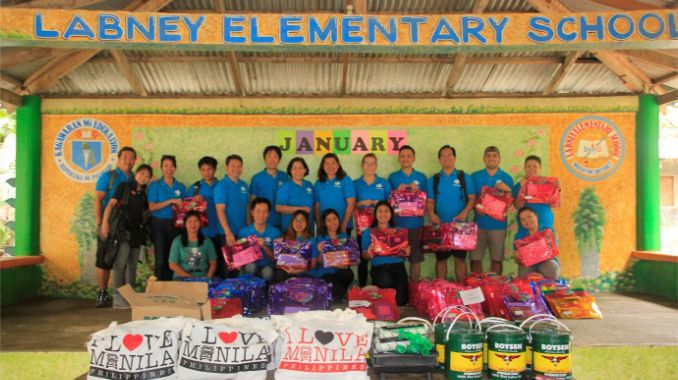
The 19 SCOP volunteers gathered in front of Labney Integrated School