Contribute to the
Carbon Neutrality of
Society
Contribute to the Carbon
Neutrality of Society
Carbon Neutrality of
Society
Neutrality of Society
The Sumitomo Corporation Group set “Contribute to the carbon neutrality of society” as a long-term goal under the Material Issue “Overcome climate change” and is involved in wide-ranging businesses that contribute to decarbonization and low-carbon initiatives worldwide. On this page, the general manager of the Energy Innovation Initiative (EII) Strategic Business Unit (SBU) explains in an interview the medium- and long-term strategies and initiatives of the EII SBU that has led the creation of energy and decarbonization businesses throughout the company since its establishment in 2021. In addition, we have also been implementing green transformation (GX) under the Medium-Term Management Plan 2026, which started in FY2024, and we introduce the main GX projects that have been making progress during the period.
Proactive EII SBU Initiatives Driving Contributions to the Carbon Neutrality of Society
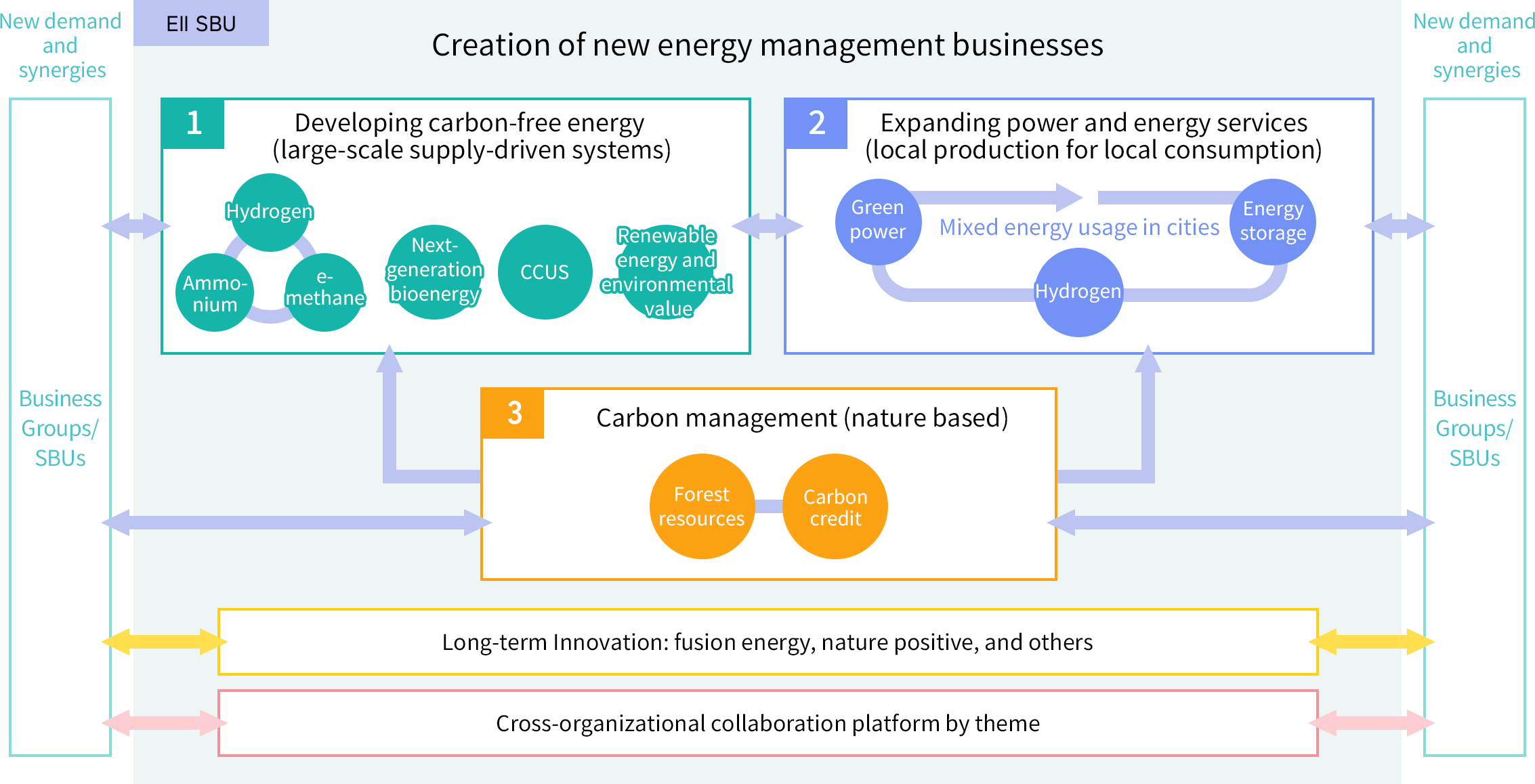
Through an interview with Seiji Kitajima, General Manager of the EII SBU, Energy Transformation Business Group, we introduce the EII SBU’s initiatives that are driving our efforts to “Contribute to the carbon neutrality of society,” as stated in the Material Issues. In the EII SBU, each business unit is creating new businesses that contribute to the carbon neutrality of society through three priority areas. In addition, the Cross-Industry Collaboration & Development Unit performs cross-organizational functions for the entire company with the objective of creating new businesses by promoting cross-organizational collaboration toward formulating an overall strategy that provides a comprehensive view of the entire value chain.
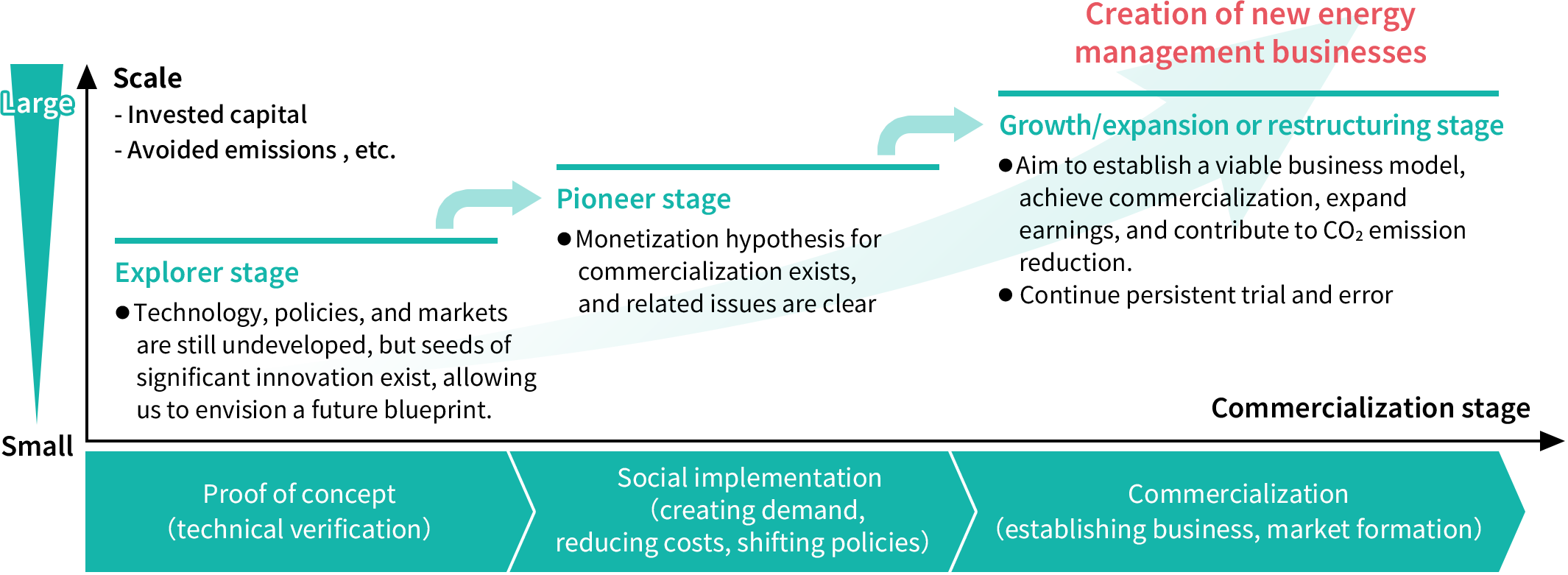
In new business development, as shown in the diagram below, we categorize each business into three stages according to market maturity, technology level, the status of establishment of monetization models, and external factors including systems and regulations. For each stage, we clearly define what should and can be done at present, steadily execute, and advance our efforts toward business creation.
Growth Story for the Creation of New Energy Management Businesses
In cross-organizational collaboration, we take themes society faces as a starting point, identify the relevant SBUs within the company, encourage collaboration, and carry out agile business development and organizational optimization.
The Seeds of Business Can Be Found at the front line of business—Building a New Revenue Pillar from Decarbonization Through Collaboration with Business Groups

Climate change is a major challenge facing humanity. Precisely because it is such a significant challenge, we see it as an opportunity to create new businesses by addressing it. It was with this belief that we established the EII SBU in April 2021. The EII SBU is an organization that coordinates decarbonization initiatives previously conducted independently by individual business groups and facilitates company-wide collaboration to commercialize them. It also seeks to create a new pillar of revenue for the company’s future.
The EII SBU’s three priority areas are “developing carbon-free energy”, “expanding power and energy services” and “carbon management.”Among these are a wide range of initiatives, from those with short time frames to monetization to medium- and long-term projects, including the large-scale battery storage businesses and renewable energy-related businesses that have already been commercialized and are expected to grow substantially in the future, as well as fusion energy*1, which has only begun moving toward practical applications. Accordingly, we categorize each project into one of three stages: explorer; pioneer; or growth/expansion or restructuring. By clarifying what needs to be done now, we seek to achieve results from the perspective of each stage. Both projects that generate profits in the short to medium term as well as fields where we persistently engage in trial and error for the future, even if results do not appear immediately, are important, and therefore, it is crucial that we take actions with a firm awareness of the required time frame for each.
- *1 A fusion reaction refers to the process in which light atomic nuclei, such as hydrogen, fuse together to form a slightly heavier nucleus, such as helium, releasing a substantial amount of energy. The thermal energy generated through this reaction can be harnessed for power generation. As it offers stable fuel supply and emits no greenhouse gases (GHGs), it is expected to serve as a next-generation primary energy source, alongside or in place of nuclear fission and fossil fuel power.

When the EII SBU was established, we created a cross-organizational collaboration platform with the objective of consolidating knowledge and resources scattered throughout the company for use in commercialization and organizational structuring. As a result, we have created projects that never would have existed if it were not for the EII SBU. To give one example, there was an understanding of the importance of carbon credit throughout the company, but the company’s policy and strategy was not clear. The Carbon Solution Business Unit, which was launched through the cross-organizational collaboration platform, formulated strategies and internal rules for handling carbon credits and has established a track record while collaborating with various business units. Active trading of carbon credits has contributed substantially to the formation of a market, and under the Market Maker Mechanism*2 implemented on the Tokyo Stock Exchange’s carbon credit market, we have been recognized as a Best Market Maker for two consecutive years. In addition, we are taking on the challenge of creating carbon credits derived from overseas mangrove afforestation.
- *2 A scheme to maintain stability in financial markets' overall trading volumes by assuring that orders placed by market participants are executed, facilitated by continuous price and volume quotations from market makers authorized by the stock exchange.
To create new businesses that can solve the major challenge of climate change, collaboration with other companies, universities, and government agencies will be essential. In this regard, the trusting relationships that each of the company’s SBUs has built up over many years with partner companies and outside organizations has been a major strength for us. The issues that become the seeds of business can be found at the front line of business where we have contact with customers. As each individual takes pride in creating next-generation businesses, we will continue to steadily commercialize themes relating to low-carbon and decarbonization through collaboration with each SBU, thereby contributing to the carbon neutrality of society.
For a more in‑depth interview on EII’s efforts to realize a carbon‑neutral society, please visit the link below.
Creating New Businesses to Realize a Carbon-Neutral Future: Challenges Addressed by the Energy Innovation Initiative|Sumitomo CorporationAvoided emissions: Quantifying the Contribution to Society’s Carbon Neutrality
The avoided emissions are quantification of emissions from society avoided when new products and services replace earlier ones. We use this as an indicator to visualize the contribution by our businesses to achieve a carbon-neutral society during internal discussion. The transition to a decarbonized society will be a long-term process, and during this process, a wide range of new products and services will be needed. In addition to developing low-carbon products, the Sumitomo Corporation Group is advancing the supply of materials essential for renewable energy and initiatives toward market expansion.
As one example, the avoided emissions for FY2024 through the operation of our renewable energy business are indicated below.
| Details of Contribution | Baseline | Calculation Formula | Avoided Emissions |
|---|---|---|---|
| Contribution by creating renewable energy |
Energy mix of each country |
Power generating facility capacity [MW/year] × Annual operating hours × Emission factor [t-CO2/MWh] × Sumitomo Corporation’s ownership percentage |
2,840 thousand t-CO2e |
It should be noted that the avoided emissions are reference indicators showing the extent of our contribution to society through our businesses and do not represent a set off the Group’s GHG emissions.
- Main guidelines used as reference
- ・GX League, “Basic Guidelines for Disclosure and Evaluation of Climate-related Opportunities” (2023)
- ・WBCSD/WRI, “GHG Protocol Corporate Accounting and Reporting Standard” (2019)
- ・WBCSD / Net Zero Initiative, “Guidance on Avoided Emissions” (2023)
- ・Ministry of Economy, Trade and Industry, “Guidelines for Quantifying GHG emission reductions of goods or services through Global Value Chain” (2018)
Accelerated new growth driven by GX
In the Medium-Term Management Plan 2026, which started in FY2024, we identified “Accelerated new growth driven by GX” as an initiative, and in the short term, we will use GX to reinforce those businesses in which we have strengths and competitive advantages while taking action to develop new strengths for the future in various industrial fields over the medium to long term. In particular, we believe the following three areas will be crucial for advancing GX: GHG capture, storage, and utilization; transition to decarbonized/low-carbon energy sources; and energy/resource conservation (efficiency improvement). Below, we provide examples of initiatives as part of the Medium-Term Management Plan 2026.
GHG capture, storage and utilization
In addition to the traditional supply of forest products, we are focusing on the CO2 capture and storage functions of forests and tackling new business challenges such as creating carbon credits. In addition, by using timber and bio-based materials, which can themselves serve as substitutes for fossil raw materials and fuels, in downstream sectors such as fuel and green chemicals, we are working to develop new products and businesses that contribute to the decarbonization of society and support CO2 capture, storage, and utilization.

Support for mangrove afforestation, which absorbs more CO2 than tropical forests, to create one of Africa’s largest blue carbon initiatives.
Entering the Carbon Credit Business Through Mangrove Reforestation in Madagascar and Mozambique | Sumitomo Corporation
Transition to decarbonized/low-carbon energy sources
We set a policy of continuously shifting to a power generation portfolio with lower environmental impact, and since the 2000s, we have continuously engaged in the development of renewable energy projects, mainly wind power generation projects. As of March 31, 2025, our net ownership generation capacity for renewable energy projects was approximately 2 GW). Looking ahead to our target of achieving carbon neutrality by 2050, we are undertaking renewable energy business in line with energy demand as well as decarbonization and low-carbon targets in partner countries.

Offshore wind power generation with projected annual power generation covering the electricity consumption of approximately 800,000 people in France.
Financing secured and construction works commence for Eoliennes en Mer des Iles d’Yeu et de Noirmoutier Offshore Wind Farm Project in France | Sumitomo Corporation
Photo credit: @EMYN - Christophe Beyssier

Business development of green electric power platforms covering the entire value chain to become India’s largest Japanese-affiliated power generation operator.
Sumitomo Corporation Establishes Renewable Energy Development and Supply Company in India | Sumitomo Corporation
Energy/resource conservation (efficiency improvement)
We are advancing project development with consideration for environmental performance, including acquiring CASBEE A rank or higher certification for logistics facility projects to be acquired or developed in the future and, in principle, obtaining ZEB, ZEB Ready, or ZEB Oriented certification for office building development and renovation projects.

Renovation of a large-scale building with a 60-year history and acquisition of ZEB Oriented certification.
Sumitomo Corporation's "Second Birthplace" in Kanda – Public-Private Partnership for Urban Planning that's Fun to Explore | Sumitomo Corporation

Introduction of U.S.-manufactured smart glass in a logistics facility in Japan for the first time with the expectation of reduced power consumption.
Sumitomo Corporation Explores the Optimal Solution for Logistics Facilities Through SOSiLA | Sumitomo Corporation
Examples of the Sumitomo Corporation Group’s initiatives to contribute to the carbon neutrality of society can be found on our owned media, Enriching+. Please visit Enriching+ for more information.