Rikkyo School in England & SCEU: A Hands-On Program for Tackling Social Issues
U.K.
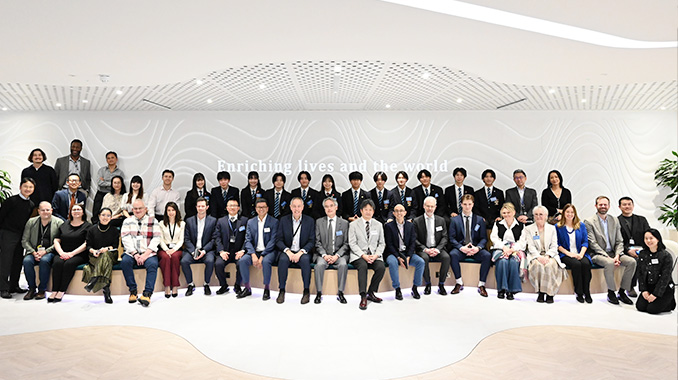
Sumitomo Corporation Europe Limited (SCEU) held a special program, the "Global Talent Development Project," in partnership with Rikkyo School in England, a Japanese boarding school that shares SCEU's vision of developing global talent, in which SCEU members worked with students to explore social issues from multiple perspectives. With SCEU's CEO also serving as a member of the school's board of directors, the two organizations have established a strong partnership to plan and deliver a five-session program running from November 2025 to March 2026. Twelve students, selected from grades 10 to 12, participated. In the final session, students gave presentations at SCEU's London office under the theme “How to realize 'No.1 business strategy' by contributing more to the society,” followed by opportunities to interact with SCEU employees.
Session 1: Online Session
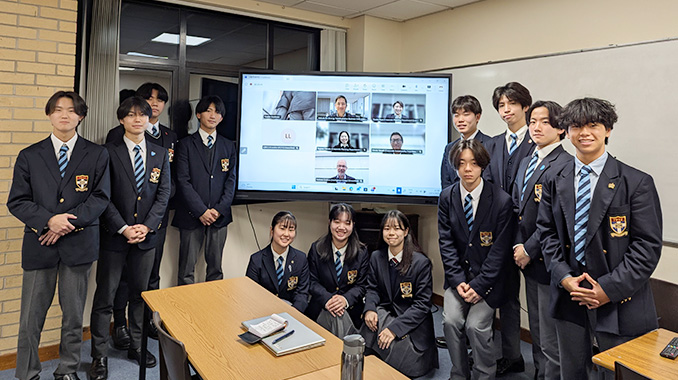
The first session was held online, with Mr. Koike, CEO of SCEU, introducing the history and philosophy of Sumitomo Corporation, the breadth of its businesses, and its business strategies. He explained how the Sumitomo Corporation Group has grown by responding to change while addressing social issues, helping students gain a deeper understanding of the company’s approach.
This was followed by a presentation by Mr. Kakuda, Deputy Head of EX Business Unit, on the theme “How to Realize a Carbon-Neutral Society.” He outlined the fundamental challenges related to energy issues and explained the company’s concrete initiatives toward achieving a decarbonized society.
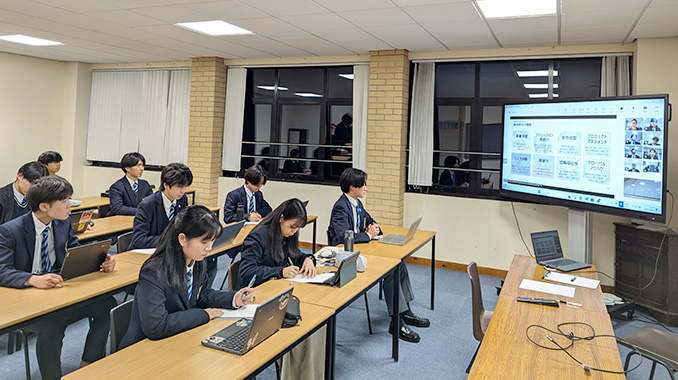
The students demonstrated remarkably deep insight into the means required for decarbonization, the need for social transformation, and the role of corporations, asking sharp questions throughout the session. Some approached the topic from a philosophical perspective, making the discussion lively and intellectually stimulating.
Building on what they learn in each session, students deliver presentations at the following session. Divided into three groups, they took on the assignment of developing business proposals aimed at realizing a decarbonized society. Thus began a five-month challenge designed to sharpen critical thinking skills and strengthen their ability to express ideas in their own words.
Session 2: Panel Discussion at Rikkyo School in England
In the second session, members of SCEU and SCSK Europe visited Rikkyo School in England and held a panel discussion for all 172 students. Representing SCEU were Mr. Koike and Mr. Kakuda, continuing from the first session, while Mr. Shibazaki, Managing Director of SCSK Europe, also joined. They spoke passionately about the Sumitomo Corporation Group’s businesses, diverse career paths, leadership, and commitment to contributing to society. Students asked questions enthusiastically, and the discussion became so engaging that time ran short.
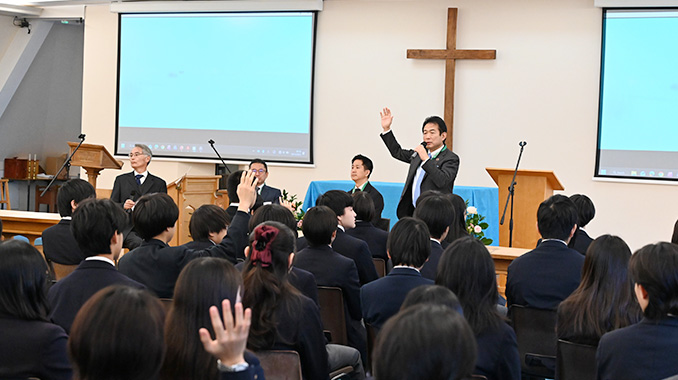

The speakers’ messages, grounded in their own professional experiences, resonated strongly with the students, many of whom reported a broadened perspective and a renewed sense of future possibilities.
This was followed by the second session of the program for the 12 selected students. The three groups presented the business proposals they had prepared as homework from the previous session, focused on realizing a decarbonized society. Despite limited preparation time due to overlapping exam periods, the students delivered persuasive ideas that incorporated real-world business perspectives, drawing expressions of surprise from the corporate participants. Afterwards, they listened attentively to professional feedback and reflected seriously on their own futures. Several students commented that it was “the best class of the year,” making the session a deeply meaningful learning experience for both sides.
In addition, under the theme “Leveraging Rapidly Evolving Technologies,” Mr. Shibazaki and Mr. Chiba, Deputy Managing Director of SCSK Europe, delivered a lecture on the continued advancement of AI. Together with the students, they explored both the potential for dramatic positive social change and the potential downsides and risks associated with AI.
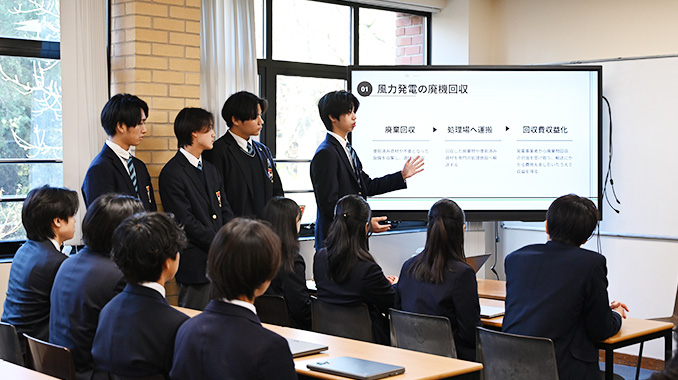
Session 3: Envisioning the Future Driven by Technological Innovation
In the third session, students took on a complex theme, presenting the future they aim to realize through technological advancements by 2050 and the potential this holds for business. While they grappled with developing their ideas in sufficient depth, they demonstrated perseverance, creativity, and emerging critical thinking throughout their work.
The discussions following the presentations were highly engaging. Insights were shared regarding the importance of thinking boldly and the possibilities of exponential technological progress. Constructive feedback was also provided on how the students could strengthen the structure and clarity of their content, supporting them in making their proposals more impactful.
In the second part, European Automotive Business Unit General Manager, Mr. Fujimoto and manager, Mr. Nakajima delivered a lecture on the future of mobility. They introduced emerging trends and innovations that will shape mobility in the years ahead, covering automobiles, aircraft, and fields beyond.
Session 4: Turning Next-Generation Technology into Business Ideas
In the fourth session, the students divided into three teams and presented bold visions: teleportation by information transmission between clones, full-dive VR as a substitute for real-world experience, and next-generation flying cars. What stood out was not only their imagination but also their willingness to question fundamental concepts taken for granted in daily life.
Their thinking pushed far beyond mere technology into memory, identity, society, and the meaning of real versus virtual experience, asking questions such as: What is the true purpose of “movement”? Is the goal reaching a destination, or gaining an experience? Where does human value lie in a world of AI, simulations, and advanced automation?
SCEU's role was to meet these futuristic ideas from an equally practical, real-world perspective, which included the ultimate question of whether they are viable as businesses. Through the discussions, the importance of connecting vision with real-world viability was emphasized. Specifically, they examined what social issues would be solved, who would benefit, what markets could form, and how scalable these concepts could be.
Following the students' proposals, a session was held to introduce a logical framework for building business ideas toward 2050 under the theme “Achieving the No. 1 Business Group.” This framework provided the students with a clear foundation for further refining their ideas toward the final stage of the project.
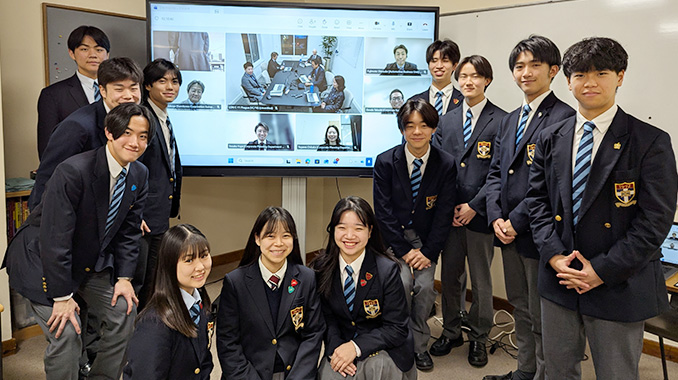
Session 5 (Final Session): Presentations at the London Office
On March 4, 2026, the final presentations of the five-month "Global Talent Development Project" with Rikkyo School in England were held at the SCEU London office.
Across the five sessions, the students explored key global business themes relevant to Sumitomo Corporation. While envisioning a hopeful world in 2050, they focused on social issues such as a carbon-neutral society, the evolution of technologies like artificial intelligence (AI), and the future of mobility. They challenged themselves to propose how the Sumitomo Corporation Group could achieve a "No.1" position in each of these fields.
The program concluded with the final presentations, showcasing not only the students' growth in critical thinking but also their ability to develop their ideas into practical and socially relevant proposals.
The three student teams presented on the following themes:
・An AI education and job-matching platform designed to help individuals leverage their skills and continue providing value in society in the age of AI.
・An immersive virtual reality (VR) solution utilizing full-dive VR to foster human connection and reduce social isolation in an aging population.
・The future of flying cars and their potential impact on society.
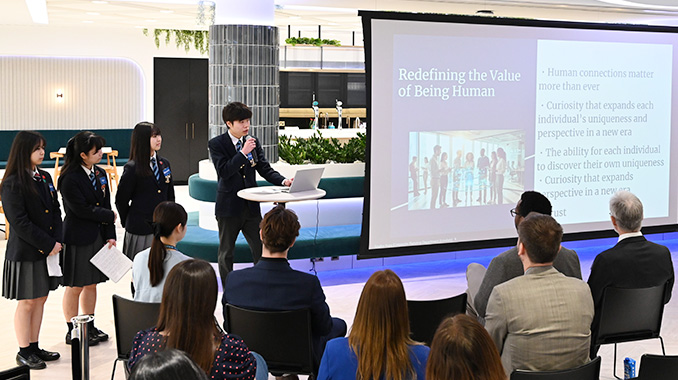
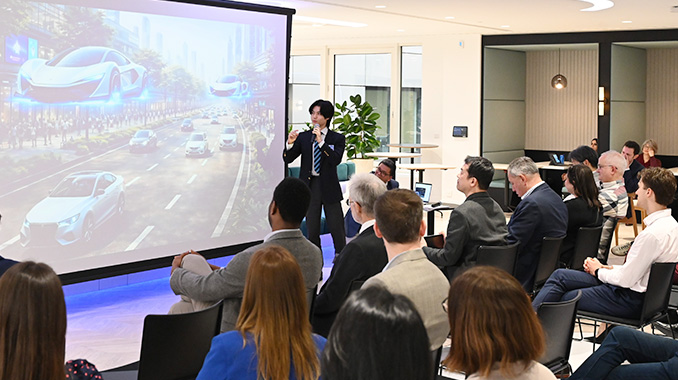
For many of the students, delivering creative business proposals entirely in English and engaging in a live Q&A with SCEU employees was a major challenge as well as a stimulating experience. However, they enjoyed the opportunity, demonstrating clear communication, thoughtful responses, and a confident attitude, reflecting how much they had grown throughout the program.
On this day, the son of the CEO of EEW (a Sumitomo Corporation Group company), who was on a short-term internship at SCEU, also joined the presentations and lunch, creating an opportunity for cross-cultural exchange and the sharing of ideas. For SCEU employees, the presentation session and lunch offered fresh perspectives and renewed energy. It also provided a valuable opportunity to reflect on the Sumitomo Corporation Group's business strategies and social responsibilities through the lens of the next generation.
The initiative also reaffirmed the Sumitomo Corporation Group’s belief that dialogue with young global talent is essential for navigating the AI era and building a more sustainable and inclusive future.