VISIONS Magazine (December 2025 Edition)
Dual Engines of Progress: Be8 and Abra Help Sumitomo’s SAF Ambitions in South America Take Flight
With global demand for Sustainable Aviation Fuel (SAF) rising fast, Sumitomo Corporation do Brasil is taking a larger role in low-carbon aviation. Looking to opportunities for future success, SC Brazil is building the supply capacity and commercial pathways needed for a long-term SAF business, one that can expand beyond Brazil. Two recent partnerships—one with Be8 and another with Abra Group—show how the region’s strengths can shift the pace of decarbonization.
Be8, formerly BSBIOS, has expanded its biodiesel production and spent years cultivating the agricultural and industrial depth that a real SAF supply chain requires. Its Omega Green project in Paraguay, the advanced biofuels plant in the Southern Hemisphere, aims to produce SAF and other renewable fuels at commercial scale. Abra brings a different kind of muscle: Gol, Avianca, and Wamos Air under one umbrella, operating more than 300 aircraft across 140 destinations. One company knows how to make the fuel; the other knows how to use it—and what it will take to bring it to market.
These capabilities match what SC Brazil needs right now. Takamasa Ueda, Senior Director and Head of SC South America’s Energy Innovation Initiative, said Be8 fills a critical space between agriculture and advanced fuels.
“We have variety of Agriculture sector business and biofuel business, including SAF," Ueda explained. “However, we do not have feedstock networks enabled to support large scale biofuel production, which exists in between the two industries where we actively work. Be8’s very strong feedstock supply networks and biofuel production capabilities are a perfect match for what we lack between the two markets.”
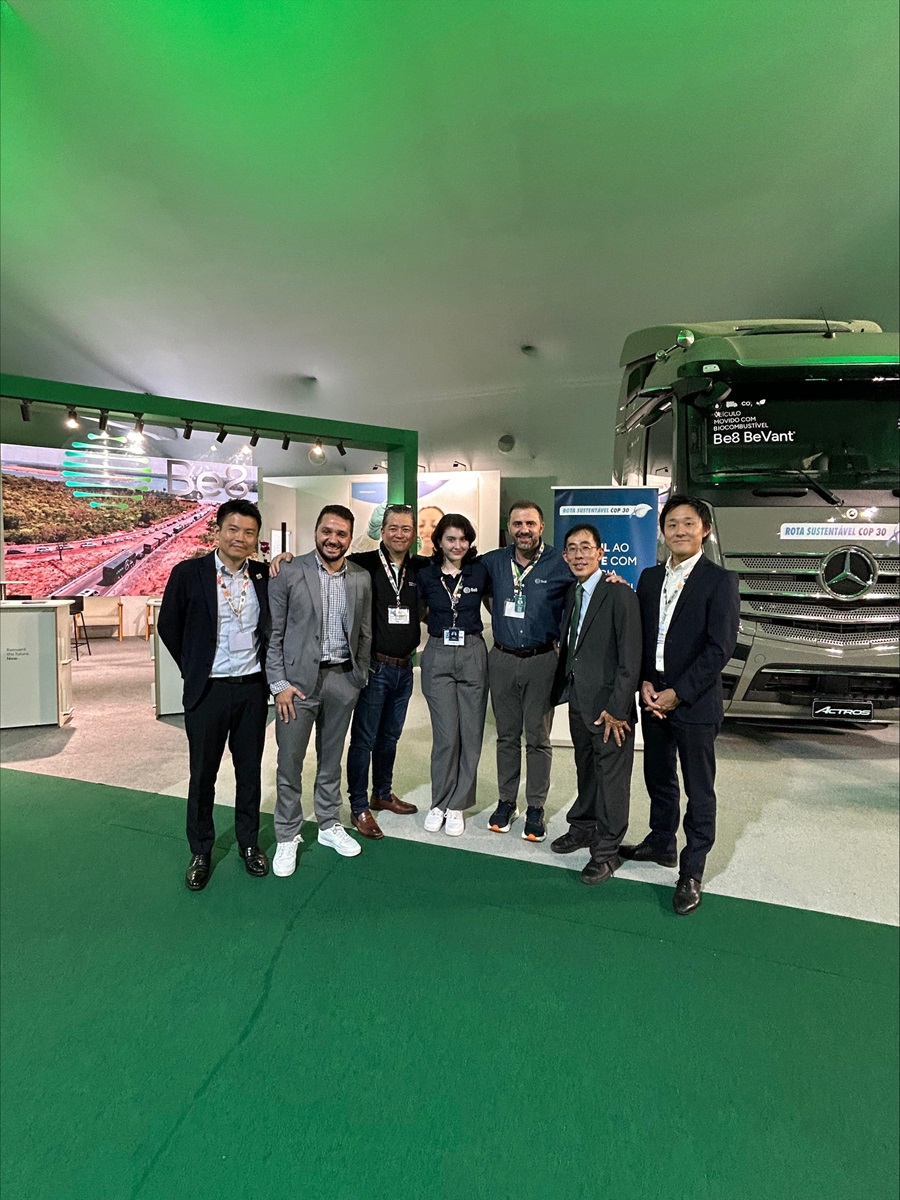
pictured above: Representatives of SC Brazil and Be8 partnering at COP30 (30th Conference of the Parties), a major United Nations climate change conference held in Belem, Brazil in November of 2025
Abra, in turn, helps open the other half of the SAF equation: demand, policy alignment, and the long-term commitments that make a new fuel market real. Ueda said the industry still faces a steep price gap between SAF and conventional jet fuel—one that requires more than private investment to close.
“These two activities can be connected, but they do not necessarily have to be integrated," noted Ueda. "In any scenario, increasing SAF supply will remain the key challenge for the industry, and the largest bottleneck is the price gap between SAF and conventional fossil-based jet fuel. The purpose of the MoU with Abra is to involve both the Brazilian and Japanese governments so that the cost and benefits of SAF development can be shared. This approach is intended to motivate both countries to participate in the Japan–Brazil Joint Crediting Mechanism (JCM), which supports decarbonization projects by allowing countries to share emissions-reduction credits.”
The Japan–Brazil Joint Crediting Mechanism sits at the center of this logic. Instead of pushing fuel across hemispheres, the JCM allows both countries to share emissions reductions through certificates. It’s a system built for efficiency and a good fit for a region that produces more feedstock than it consumes.
“As mentioned earlier, JCM will help Japan and Brazil share both the costs and the benefits of SAF development," Ueda said. "Brazil has significant supply potential of SAF but relatively limited domestic demand of the jet fuel, while Japan has strong demand but much less access to the reasonable scale of feedstock. While SAF produced in Brazil can be physically transported to Japan, it is more efficient to use emissions certificates under the JCM instead of shipping fuel long distances. The certificate-based approach saves on freight costs and reduces CO₂ emissions compared with transporting feedstock from Brazil to Japan for SAF production. Finally, if the JCM can be expanded beyond SAF into other biofuel opportunities, the benefit will be even greater. We consider it meaningful that Abra is joining us in advocating for JCM adoption within Brazil.”
Together, Be8 and Abra give SC Brazil something rare: momentum from both ends of the SAF chain. Be8 strengthens supply; Abra clears the runway for demand, policy support, and eventual offtake. As Ueda described it, the two programs are equally important for the industry, they need to move in the same direction.
“We have several other programs underway, but these agreements demonstrate both the strong future potential of Brazil and our serious commitment to addressing the challenges of building the SAF market. The aviation sector needs a much larger SAF supply to achieve real decarbonization. To reduce costs, supply must be expanded, and production must be scaled up. Many different tools and partnerships are needed to unlock these opportunities. These two programs are small but important first steps.”
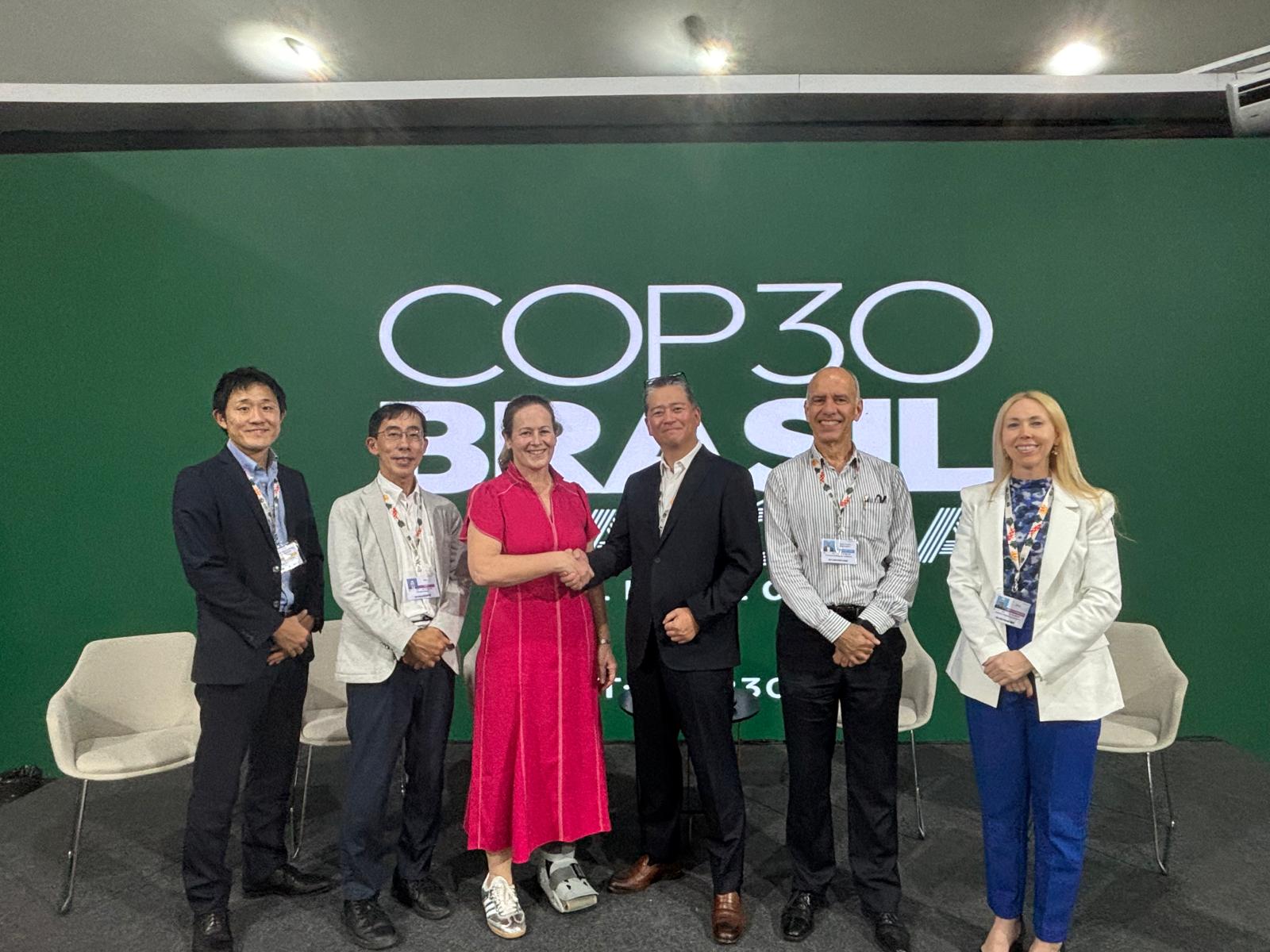
pictured above: Representatives of SC Brazil and Abra also attending the COP30 event
And the region’s potential stretches well beyond aviation. Ueda pointed to the agricultural capacity of Brazil and its neighbors, noting the unusual balance of abundant feedstock and comparatively modest domestic fuel demand—a combination that makes South America a natural export engine.
“We believe Brazil and the broader South American region can become a true production hub capable of supporting global demand for biofuels—not only SAF. Our estimates suggest that Brazil alone could supply up to one-third of global SAF demand by 2050. Similar potential exists for other biofuels such as biodiesel and bioethanol. South America, especially Brazil, is important because the region has abundant agricultural resources to expand feedstock supply to the global market.”
With Be8 driving the upstream engine of feedstock and production, and Abra powering the downstream engine of market demand and policy support, Sumitomo Corporation Brazil is assembling a biofuel ecosystem designed for growth. The partnerships created early steps, but they move with intent—steady, practical, and aimed squarely at the future of flight.