VISIONS Magazine (January 2026 Edition)

CES 2026: Practical Signals for the Next Phase of Mobility
The Consumer Electronics Show has long served as an early indicator of where mobility technology is heading. At CES 2026, the signals were notably grounded. Rather than emphasizing distant possibilities, discussions with OEMs and Tier 1 suppliers reflected an industry increasingly focused on execution, integration, and readiness for production.
For SC Automotive Engineering USA (SCAEUS), an SC Group Company, the week in Las Vegas was defined by sustained engagement with customers across the mobility ecosystem. Justin Isaacs, Vice President, Principal, and Principal Project Manager at SCAEUS, noted a clear shift in tone from previous years.
“There was far less interest in speculative roadmaps and much more focus on what can realistically be integrated, validated, and supported within active vehicle programs,” Isaacs said. “The emphasis was on delivery rather than demonstration.”
Across those conversations, several consistent themes emerged that point to where the industry is concentrating its near-term efforts.
Artificial Intelligence Moves into the Software Stack
One of the clearest shifts at CES was how artificial intelligence was discussed. AI was no longer framed primarily as a demonstration technology, but as a production system with concrete implications for validation, safety, and integration. Conversations focused on how trained models are embedded in vehicle software architectures and how they perform in real-world conditions.
|
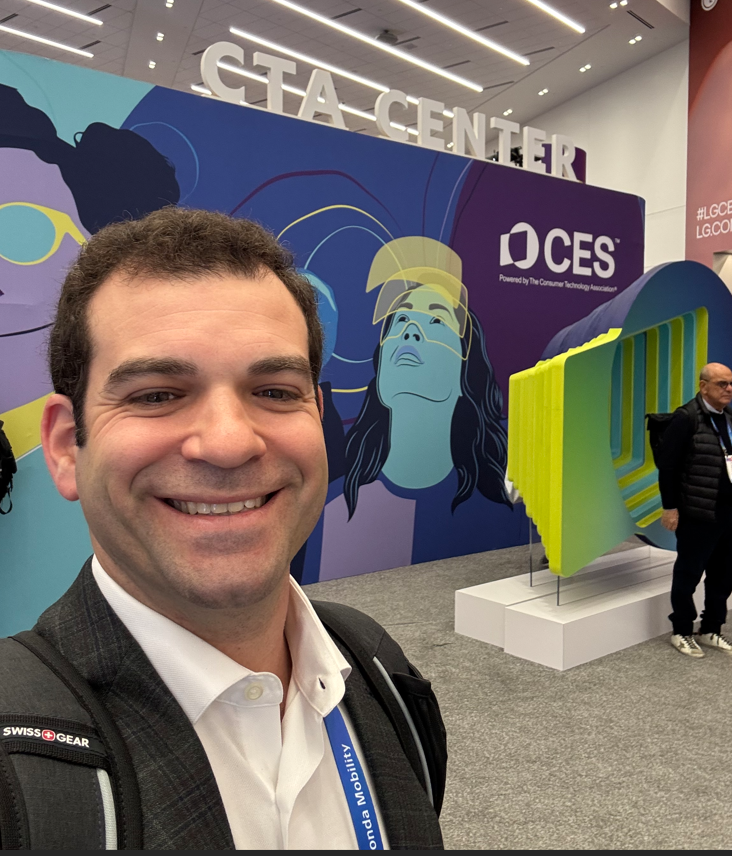
“The most consistent shift was that ‘AI in mobility’ was less about fancy futuristic demos and more about where trained AI models actually sit in the software stack, how it gets validated, and how it behaves when it meets messy real-world edge cases,” commented Justin Isaacs, Vice President, Principal, and Principal Project Manager at SCAEUS (see here left at CES). |
Software-Defined Vehicles Require Platform Thinking
A second recurring theme was the growing pressure software-defined vehicles are placing on traditional development approaches. OEMs are increasingly evaluating success at the platform level rather than feature by feature, with an emphasis on repeatability, safety, and cost control over the full vehicle lifecycle.
Isaacs observed that the key question has shifted from whether a feature can be built to whether a platform can reliably support repeated deployment under real-world constraints. This mindset is driving decisions around reusable architectures, standardized components, and faster verification loops.
Virtualization and cloud or hybrid development environments are becoming central tools for reducing integration ambiguity and supporting continuous deployment strategies.
Energy and Power Constraints Come into Focus
While AI-driven technologies were visually dominant on the CES show floor, deeper conversations frequently returned to a more fundamental constraint: energy availability. Power economics and infrastructure limitations are increasingly shaping how mobility strategies are evaluated and prioritized.
“On the show floor, ‘AI everywhere’ is visually dominant,” Isaacs said, “but the limiting factor is increasingly infrastructure and energy availability. That is not hypothetical anymore.”
As AI workloads expand and data center demand grows, power access, efficiency, and cost are becoming first-order considerations. These constraints are influencing not only technology roadmaps, but also partnership strategies and long-term investment decisions.
Redefining Speed in Engineering Execution
SCAEUS was created with the goal of moving faster and integrating more seamlessly than traditional engineering partners. At CES, customer conversations clarified that speed is now defined by disciplined execution rather than accelerated timelines alone.
“What resonated most was a very specific definition of ‘moving faster,’ which is not cutting corners,” Isaacs explained. “It is compressing the loop between requirements, implementation, verification, and release readiness, while staying compliant.”
In practice, this definition of speed emphasizes early requirements clarity, integrated test strategies, and verifiable progress that can withstand internal audits and external scrutiny.
A Grounded Industry Outlook
Taken together, the signals from CES 2026 point to an industry that is prioritizing deliverability. The focus has shifted toward solutions that can be validated, integrated, and supported over their full lifecycle, rather than concepts optimized primarily for demonstration.
As an SC Group Company, SCAEUS aligns closely with this direction. The themes that emerged in Las Vegas reinforce the importance of disciplined engineering, cross-domain integration, and operational realism as mobility technologies continue to mature.
```