VISIONS Magazine (June 2026 Edition)
No Co-Pilots Aboard: Presidio Ventures Invests in Reliable Robotics
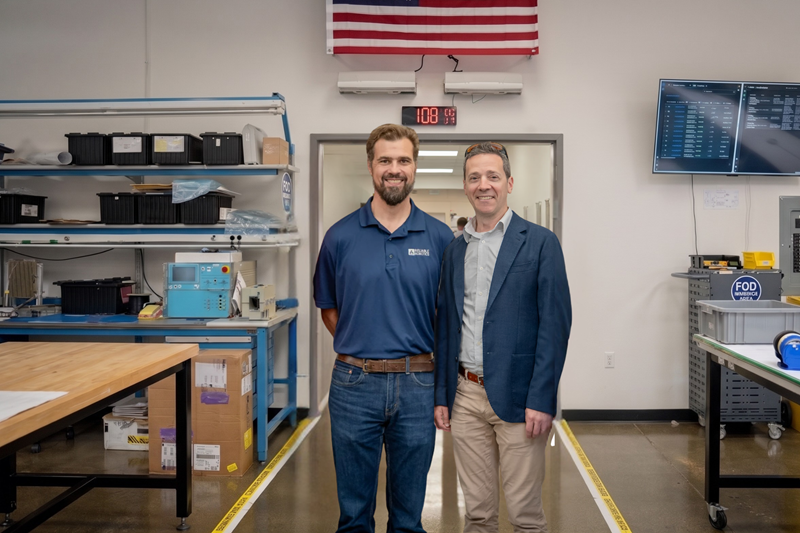
Reliable Robotics Co-founders Juerg Frefel and Robert Rose
As autonomous technologies continue advancing across transportation and logistics industries, Presidio Ventures sees Reliable Robotics as one of the few companies pursuing a practical and commercially viable path toward fully autonomous aviation.
Interest in autonomous flight systems has accelerated in recent years as aviation companies, logistics providers, regulators, and defense organizations explore how automation could reshape cargo transport, regional connectivity, operational efficiency, and long-term aviation economics.
For Presidio Ventures, the recent decision to participate in a $160 million funding round for Reliable Robotics, a company that develops automated systems to enable fully autonomous operation of commercial and military aircraft, was driven not simply by interest in autonomous flight itself, but by the company’s operational approach to certification, deployment, and commercial adoption.
As the corporate venture capital arm of Sumitomo Corporation, Presidio Ventures has historically focused on identifying emerging technologies and business models positioned to shape future industries while maintaining clear pathways toward real-world commercial deployment. The firm’s investment portfolio has included companies across mobility, logistics, automation, energy, AI, and industrial technology sectors, reflecting a broader long-term strategy of identifying operational technologies that can move from early innovation into scalable commercial use. In Reliable Robotics, Presidio Ventures saw a company pursuing not just a futuristic vision of autonomous aviation, but a practical pathway toward implementation within existing commercial infrastructure and regulatory systems.
“Well, I’ve been looking at drone technology and autonomous driving and autonomous mobility in general for a very long time,” said Masood Pirzada, CEO of Presidio Ventures. “And I think everything is possible if there were no regulations. And the regulations are directly connected to safety and reliability.”
Masood said many autonomous aviation companies face a major challenge: developing systems that can realistically operate within highly regulated commercial airspace environments overseen by agencies such as the Federal Aviation Administration (FAA).
After evaluating numerous companies over time across autonomous mobility and drone technologies, he said Reliable Robotics stood out because of its decision to work directly alongside regulators while pursuing a phased deployment strategy rather than attempting to develop a fully autonomous aircraft platform from scratch.
“What Reliable came up with is a process as a solution which had two parallel paths,” Pirzada said. “One, to continuously develop autonomous subsystems. And number two, work with the FAA to start a new certification authority within the organization to certify autonomous systems.”
According to Pirzada, Reliable’s approach focuses on integrating autonomous flight technologies into existing FAA-certified aircraft rather than attempting to certify an entirely new aircraft platform.
“They decided, ‘Okay, we’re going to take a fully certified plane, a commercial plane, a smaller plane initially, that does not require that many human beings as passengers, but instead it’s a smaller cargo plane,’” Pirzada said. “So, it’s a smaller plane by a manufacturer that’s fully FAA certified.”
Reliable Robotics selected the Cessna 208 Caravan, a turboprop cargo aircraft already widely used by logistics operators including FedEx, UPS, DHL, and others for regional and last-mile cargo distribution routes.
“What is a Cessna 208? It’s one of the most reliable last-mile grasshopper type cargo planes used by logistics companies,” Pirzada said.
Rather than redesigning the entire aircraft itself, Reliable developed retrofit autonomous flight-control systems designed to integrate into existing FAA-certified planes while maintaining the core aircraft fuselage and turbine engine platform.
“They said, ‘We’re going to keep the plane intact. We’ll keep the engine intact, but some of the flight controls, we’ll fully transform,’” Pirzada said. “‘We’ll put our software & subsystem controls in, as a retrofittable kit.’”
The company initially focused on remote-operation capability combined with autonomous fail-safe systems capable of safely landing aircraft if communications were disrupted.
“They developed that system, and they’d completely taken out some of the electronics because they wanted the planes to make it safely in case the remote flight operations connectivity gets disrupted, the plane should be able to land safely at the nearest FOB on its own, autonomously,” Pirzada said.
That incremental approach to deployment and certification became a major factor in Presidio Ventures’ investment decision.
“So, it’s a faster path to certification, and they are working in parallel with the FAA to develop documentation, to develop processes, and to develop an entire certification program,” Pirzada said. “I thought, ‘This is it, the startup company I want to invest in.’”
Reliable Robotics’ commercial potential has also attracted attention across the aviation and logistics sectors. The company has commitments for hundreds of systems from commercial and military customers following its latest financing round.
“Aviation is vital to our economy and national security, but to meet demand it needs to scale safely. Automation eases constraints, enabling us to realize greater levels of throughput at even higher levels of safety,” said Robert Rose, CEO and co-founder, Reliable Robotics. “Following Presidio Ventures’ investment in Reliable, the teams have engaged with business units and companies across the Sumitomo Corporation portfolio to identify applications for Reliable’s aircraft automation technology once FAA certification is complete.”
Pirzada pointed specifically to the operational economics surrounding regional cargo aviation as one of the technology’s most significant advantages.
“Currently, FedEx has pilots that fly these C208 cargo planes to remote areas,” Pirzada said. “For FedEx, with their entire fleet of well over two hundred Cessna 208 planes, over 70% of the time those planes are on the ground waiting.”
According to Pirzada, the issue is often not aircraft availability, but rather pilot availability, weather delays, and operational limitations tied to remote or difficult human operating environments on the ground and in the air.
“But because the pilots either are not available or the pilots cannot fly in certain remote areas, mountainous areas or islands, or weather conditions, for pilot safety reasons,” he said. “At the end of the day, it costs FedEx a lot of money because the planes end up being underutilized, instead of operating and generating revenue.”
Reliable’s model, he said, could eventually allow operators to centralize remote flight operations while keeping aircraft operating continuously across distributed cargo routes globally.
“Reliable converts the planes to become operational 24/7,” he said. “Instead of these pilots sitting in different locations across the globe waiting for the weather to calm down, or conditions to accommodate, what they say is, ‘Okay, FedEx, you create remote flight operations center, and these pilots can operate in shifts 24/7.’”
In that scenario, pilots could remotely supervise and operate flights from centralized operations centers while aircraft continue operating across multiple global regions.
“So now, you’re utilizing almost 100% of the hardware that you own, and utilizing pilots one hundred percent of the time,” Pirzada said. “So, a win-win on both sides from a business point of view.”
He also believes autonomous systems may eventually improve operational safety and reliability in difficult flying conditions through the use of AI-driven flight systems capable of processing far larger volumes of real-time operational data than individual pilots could process alone.
“The AI flying capability is much more advanced than the human flying capability because AI is not just relying on eyesight and hands/legs activity alone,” he said. “AI is utilizing actual radars and satellites and actual invisible data that human beings cannot directly utilize simultaneously for a fast and accurate decision.”
At the same time, Pirzada emphasized that commercial adoption would depend heavily on regulatory certification and public-sector readiness.
“In the public sector or commercial sector, I think it will take actual FAA approval for the adoption to take off,” he said.
Reliable Robotics reportedly expects FAA certification progress to continue over the coming year as the company has been working alongside regulators to establish approval pathways for autonomous aviation systems.
For Presidio Ventures, the investment reflects broader interest in technologies that combine long-term transformational potential with practical operational deployment strategies.
“It’s an evolving situation, and it’s going up in the right direction to catch the escape velocity,” Pirzada said. “I expect this company will change the world for the better.”