VISIONS Magazine (June 2026 Edition)
Built Robotics and Penn Engineering Advance Physical AI Safety
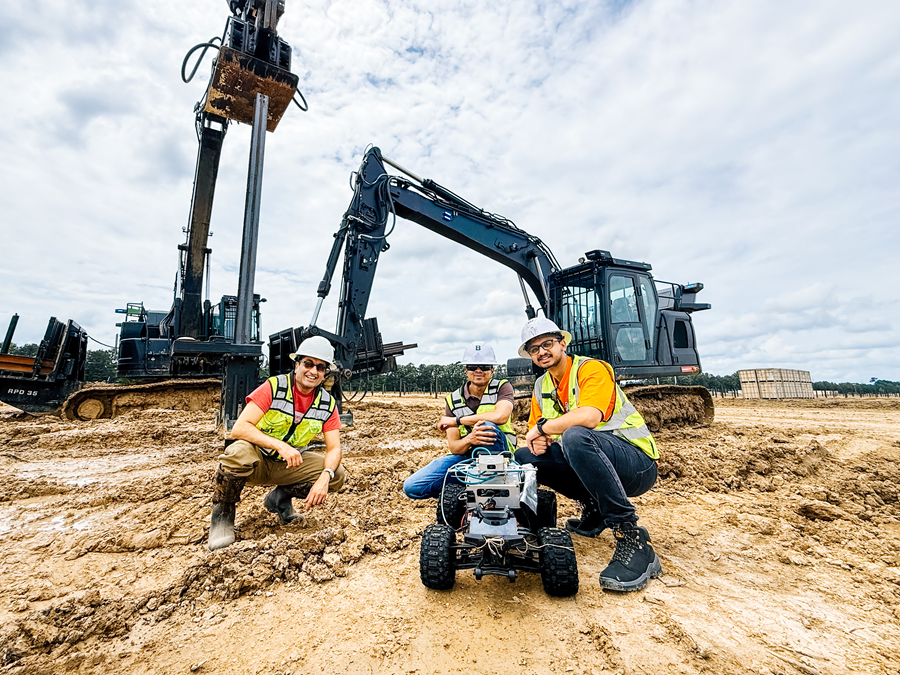
As artificial intelligence continues reshaping industries around the world, construction remains one of the most challenging environments for autonomous technology. Unlike on-road autonomy, active jobsites are unpredictable and constantly changing, including the terrain itself, requiring AI systems capable of operating safely around people, equipment, terrain, and weather in real time.
For Built Robotics, those challenges are helping define the future of physical AI.
The San Francisco-based company, which has become a leader in autonomous construction technology for utility-scale solar projects, is now partnering with Penn Engineering’s xLAB — the Safe Autonomous Systems Lab led by Rahul Mangharam, Professor in Electrical and Systems Engineering and principal investigator of xLAB — to advance the next generation of AI-powered construction systems.
The collaboration builds on years of operational deployment across solar construction projects while advancing Built Robotics’ perception systems to meet safety-critical standards and enable safer deployment of physical AI in dynamic environments.
The relationship also reflects the long-term connection between Built Robotics and Presidio Ventures, SCOA’s Corporate Venture Capital arm. Presidio Ventures has supported Built Robotics since its initial investment in 2017, recognizing early on the company’s potential to reshape infrastructure development through autonomous technology and scalable industrial AI applications.
From Automation to Physical AI
Built Robotics has steadily gained traction within renewable energy construction through autonomous systems designed to assist with pile driving, trenching, surveying, material handling and other repetitive construction tasks. In 2025, Built announced a long-term agreement with renewable energy construction leader Blattner to deploy dozens of AI-powered robots across solar projects throughout the United States — a partnership that reflected growing industry confidence in autonomous construction technology.
Now, the Penn Engineering collaboration represents the next stage of that progression.
“Construction will achieve impressive productivity gains by deploying physical AI,” said Erol Ahmed, Vice President of Communications for Built Robotics. “And while our robots have a proven track record across demanding real-world conditions, there is still more work to be done. Changing terrain and complex jobsites continue to push autonomy to its limits.”
Ahmed explained that the collaboration combines Built Robotics’ large-scale field deployment data with xLAB’s safety-focused analytical expertise.
“Never before have we combined the scale of data from the 50,000 operational hours of our robots with the analytical expertise of a safety-focused lab,” Ahmed said. “Together these efforts work towards deploying physical AI with ground-truth, complex terrain data, and using those insights to build a more robust AI model for future construction applications.”
Building Safety Into AI
Safety remains central to Built Robotics’ evolution. The initial phase of this pilot program will focus on deploying a purpose-built survey robot across active solar construction sites to collect high-fidelity environmental data. That information will enhance Built Robotics’ AI perception systems while contributing to xLAB’s broader safety architecture research.
“As a pioneer in autonomous construction safety, we had to build safety from the ground up,” Ahmed said. “This collaboration centers around a purpose-built robot that will survey vast areas of terrain on solar jobsites.”
According to Ahmed, the company’s AI model — called “Theia” — will use the new field data to better recognize edge cases involving people, terrain, lighting conditions, and obstacles.
“Historically, construction hasn’t had the rich data of other industries like on-road vehicles,” Ahmed said. “Through this initial phase of the pilot, we expect to capture a dataset that rivals what’s available for other industries including more diverse edge cases around people, occlusions, obscured lighting, and unexpected human behavior.”
The ultimate goal, Ahmed noted, is “fewer missed detections, false positives or negatives, and more reliable stop and slow decisions when working alongside people and obstacles.”
Learning From the Field
A defining aspect of the partnership is the belief that physical AI cannot be developed through simulation alone.
Built Robotics’ systems have accumulated tens of thousands of operational hours across active jobsites, giving the company access to real-world data that many autonomous systems developers have limited access to.
“Real jobsites are messy and dynamic in ways labs are designed to eliminate, but labs provide the repeatable results and formal safety frameworks that the field can’t produce on its own,” Ahmed said.
“Field experience reveals what the lab can’t simulate,” he added. “Lab simulations give structure to what the field alone can’t validate.”
That combination of field deployment and structured research reflects a broader industry shift as construction companies increasingly move from experimental pilot programs toward large-scale adoption of autonomous systems.
Expanding Beyond Solar
While utility-scale solar remains Built Robotics’ primary focus today, the company sees broader opportunities emerging across infrastructure development.
“Our mission is to build the robots that build the world,” Ahmed said.
“Our current products are trenching and pile driving, but through this research collaboration and the development of a more comprehensive field dataset, we plan to expand to more complex construction activities including pre-drill, site preparation, and material handling, while also broadening to adjacent applications such as data centers, advanced manufacturing, and battery storage.”
That broader vision reflects growing pressure across the construction industry to address labor shortages, accelerate infrastructure delivery, and improve jobsite safety simultaneously.
A New Era for Construction Technology
For Built Robotics, the growing acceptance of physical AI reflects a dramatic shift in construction over the past several years.
“There has been a tremendous shift in construction within the past five years,” Ahmed said. “What was once theory has now been proven in application after application as useful — and safer — than the ways we did it before.”
As infrastructure demand continues rising globally, autonomous construction systems are increasingly being viewed not as experimental technology, but as practical tools for helping the industry meet future needs safely and efficiently.
“Physical AI is the next evolution in helping construction address a growing workforce gap and a backlog of infrastructure projects,” Ahmed said.
As Built Robotics continues evolving from robotic automation provider to broader physical AI platform, its collaboration with Penn Engineering’s xLAB offers a glimpse into how the next generation of intelligent infrastructure systems may be designed, validated, and deployed in the real world.